Private by design
Payloads stay in your browser. Nothing is uploaded to a backend.
A clearer way to work with TMF APIs
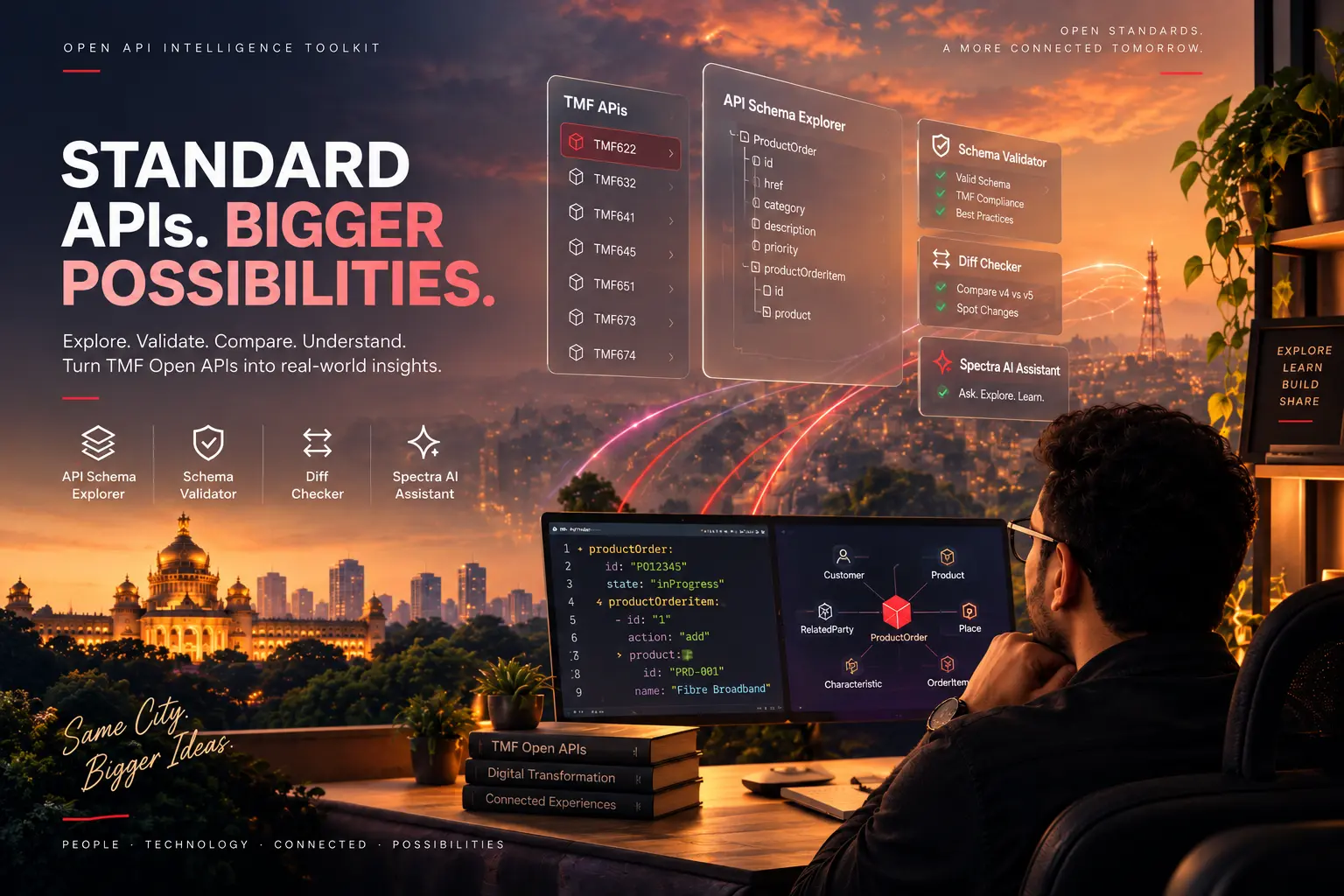
TMF API Intelligence Toolkit turns dense Open API payloads into visual, inspectable documents and gives you a browser-local place to check them against their contracts.




Payloads stay in your browser. Nothing is uploaded to a backend.
Move from a high-level map to the exact field or relationship you need.
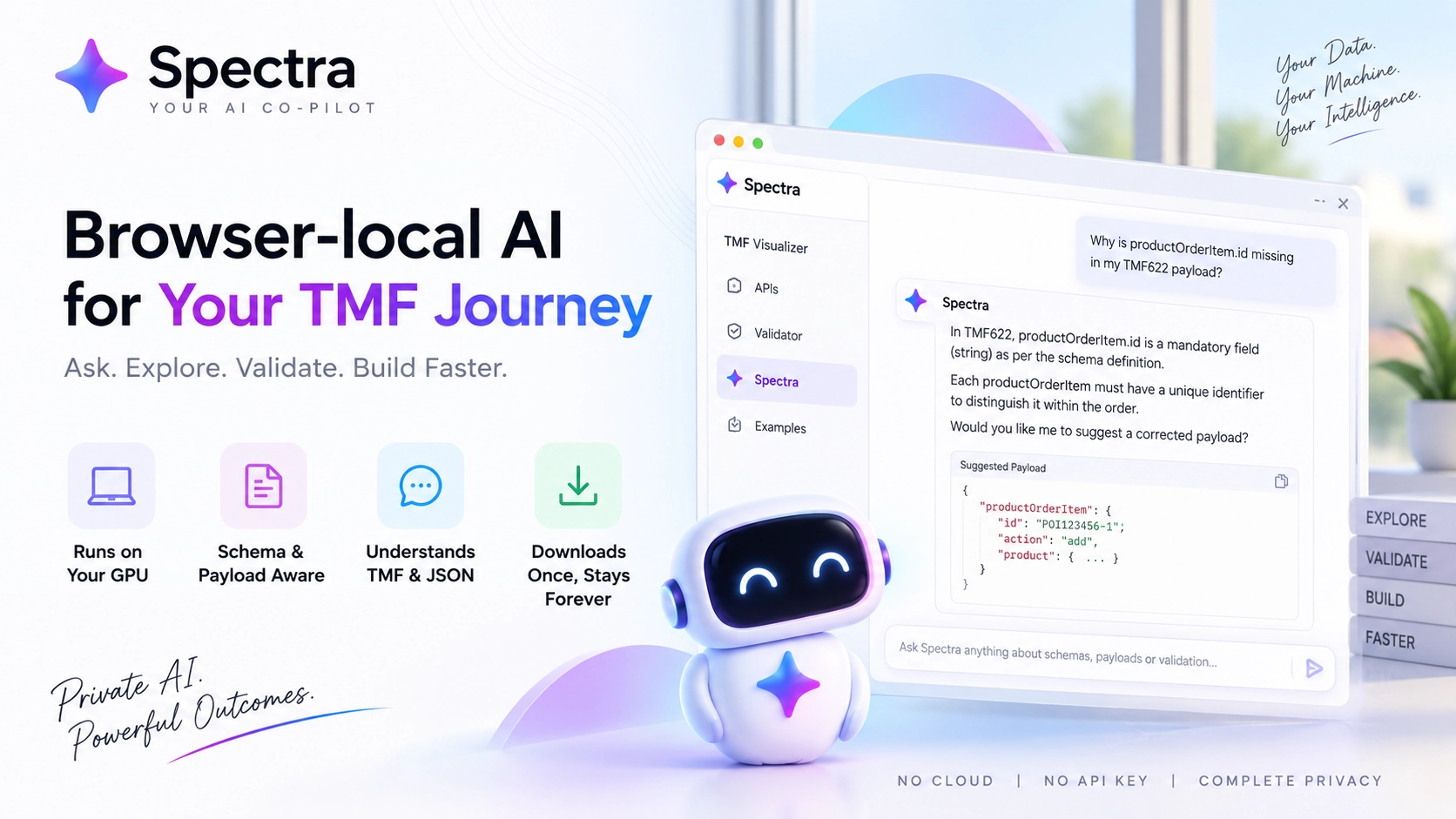
Ask questions about the current API, schema, and validation findings — answered locally on your GPU.
Clear layouts, focused documents, and exportable views for client walkthroughs.
Twenty-three instruments, one workflow
Choose an API from the navigation above, load a JSON payload, and stay focused on the meaning behind the fields.
Covering ordering, inventory, catalog, party, billing, geographic, cost, document, scheduling, and CDR domains.
Validate against both Open API generations — FVO, MVO, Create and Update variants included.
Every render, every validation, every export runs entirely inside your browser tab.
Load, inspect, validate, export — the same four-step workflow across every API in the toolkit.
No file size cap. Paste a minimal stub or a full production payload — the renderer handles both.
“Stop reading JSON.
Start reading intent.”
“No server.
No leak.
No wait.”
“From contract
to confidence.”
“Every field.
Every relationship.
Visible.”
“Built for depth.
Ready in seconds.”
Map product-order items, relationships, pricing, and characteristics.
Read agreement structure, lifecycle state, terms, and specifications.
Resolve organizations, individuals, roles, and contact relationships.
Inspect event envelopes, topics, payloads, and correlated identifiers.
Visualise Check and Query eligibility decisions, serviceability, and termination errors.
Render service order topology — items, actions, dependencies, and entity relationships.
Visualise geographic addresses, sub-addresses, coordinates, and geolocation data.
Explore site profiles, location coordinates, operating schedules, relationships, and parties.
Navigate product catalog hierarchies — categories, offerings, specifications, and bundles.
Visualise ticket severity, status lifecycle, activity timeline, related parties, and entities.
Render resource order topology — items, actions, dependencies, and relationships.
Visualise service instances, supporting resources, characteristics, and relationships.
Visualise product instances, offerings, pricing, characteristics, and related parties.
Visualise billing accounts, credit limits, payment plans, and balance history.
Visualise payment records, methods, authorisations, tax amounts, and payment items.
Render customer bills as premium invoice documents — line items, tax, applied payments, and due amounts.
Visualise qualification results — eligibility decisions, serviceability confidence, and termination errors.
Visualise actual and projected cost records — cost items, allocations, rates, and related parties.
Visualise customer profiles — engaged party, accounts, credit profiles, payment methods, agreements, and contact mediums.
Render quote documents — items, pricing, product offerings, validity periods, authorisations, and related parties.
Visualise document records — attachments, related parties, specifications, and lifecycle state.
Render appointments as rich calendar cards — time slots, related parties, calendar events, and status lifecycle.
Visualise CDR transaction records — revenue share rules, transaction items, billing parties, and settlement data.
What you get, instrument by instrument
Each tool in the toolkit is built around the same four capabilities — adapted to the shape of its API.
Order items, party roles, service dependencies, and resource links rendered as interactive graphs — follow edges without reading raw JSON.
Drill into any item: characteristics, lifecycle states, pricing, contact mediums, coordinates, or event payloads — one click from the graph or document view.
Agreement, invoice, ticket, inventory, and geographic payloads rendered as structured documents — ready for a client walkthrough or an architecture review.
Drop in a payload and run it against the published TMF Open API contract. Errors are surfaced inline — no backend, no upload, no wait.
Hybrid AI Copilot · WebGPU Local + Cloud Model Hub
Spectra is a hybrid AI assistant built into the toolkit. Run private WebGPU models locally on your GPU (zero tokens, zero cloud), or seamlessly orchestrate flagship cloud reasoning engines (DeepSeek R1/V3, Groq, OpenRouter, OpenAI, Ollama Cloud) via client-side keys.
Everything runs in the browser. Drop in a JSON payload and the visualizer renders instantly — there is no server processing, no round trip, no data leaving your machine.
Index custom PDF, Markdown, Text, and JSON user guides directly into browser-local IndexedDB. Tag documents to 23 live TM Forum APIs or Global scope so Spectra AI cites exact page numbers and business rules on every prompt send.
The schema validator runs against every published TMF Open API version — v4 and v5 — browser-local. Paste a payload, see the errors, fix the contract gap before it reaches production.
Orchestrate flagship cloud models (DeepSeek, Groq, OpenRouter, OpenAI, Ollama) alongside local WebGPU models. Chat sessions are auto-saved to client-side IndexedDB with 20-message memory and instant resume controls.
From product ordering to customer billing, from party management to geographic sites — every TMF domain in a single toolkit, with a consistent interface so you never have to re-learn the tool.
Spectra is a hybrid AI copilot (WebGPU + Cloud AI Model Hub) that knows the active API, schema version, and uploaded PDF documentation. Ask why a field is failing, what a schema rule means, or how to fix a payload gap — entirely private, zero server storage.
A practical loop
A dependable rhythm for solution architects and integration teams.
Drop in a payload or open the live JSON editor.
Follow relationships, metadata, and contract targets without losing context.
Export a clean visual view for architecture reviews and client conversations.
Built for solution architects, API teams, and order managers working at TMF depth.